A personalized AI medication service that explains drug information in plain language and helps users manage their own and their family’s medications and schedules.
How it started
Started as a Pusan National University capstone project. Drug information is scattered, so it is hard to check whether a given medicine is safe for your current health condition. We set out to make that easy.
Team and my role
MY ROLEBackend & AI
Drug and supplement DB, search and autocomplete, reminders, risk and caution information, data preparation, AI chatbot
Backend and AI developmentImplemented drug-related backend features, reminders and logs, friend invitations, family profile switching, the data preparation pipeline and AI chatbot.
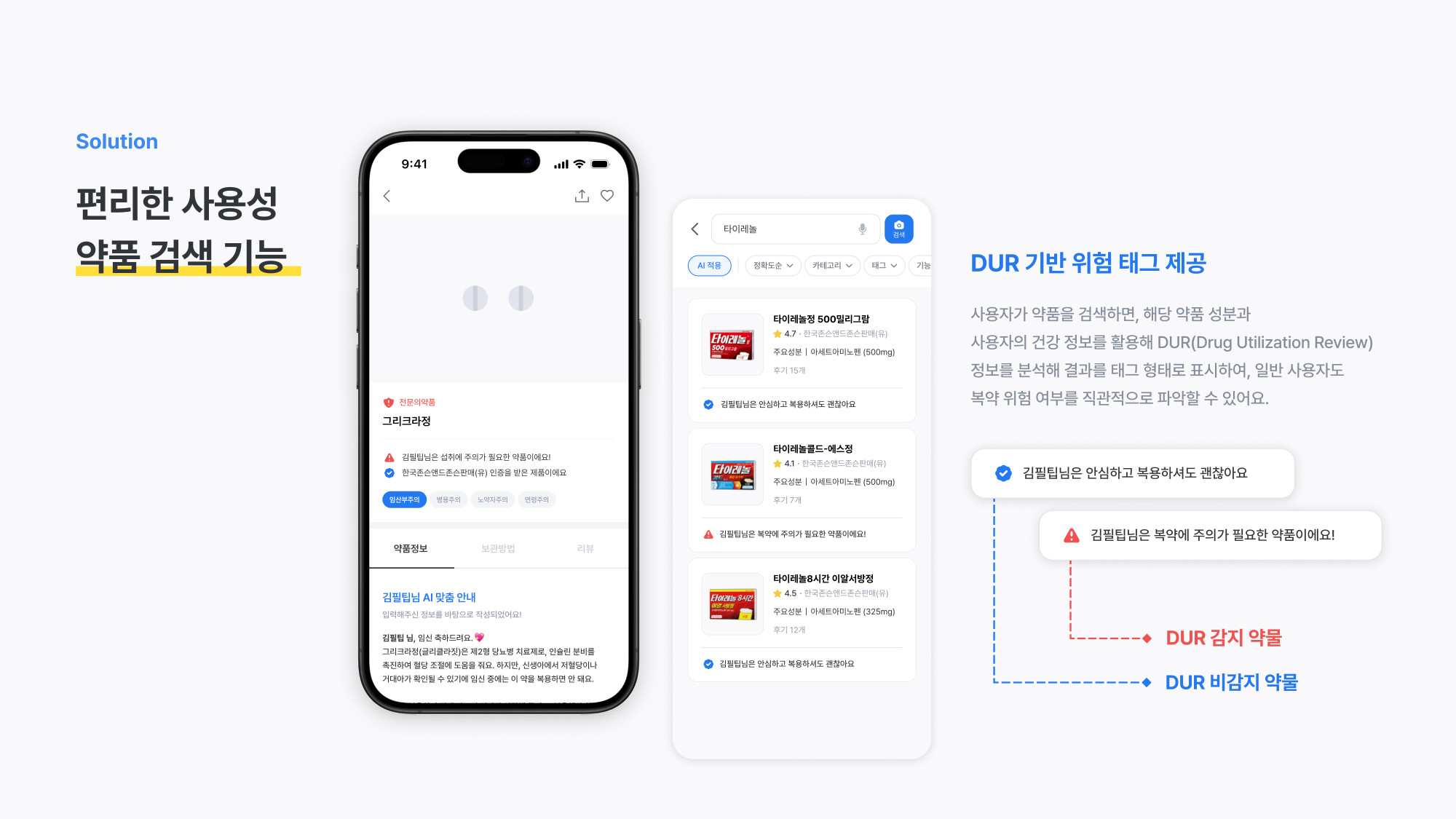
Drug and supplement modeling, search, autocomplete and risk informationDesigned the drug and health-supplement DB and implemented search autocomplete with Elasticsearch and Redis, plus Drug Utilization Review (DUR) risk and caution information. Cut search responses that took 5–7s because of LIKE queries and multiple JOINs to 0.8s on average.
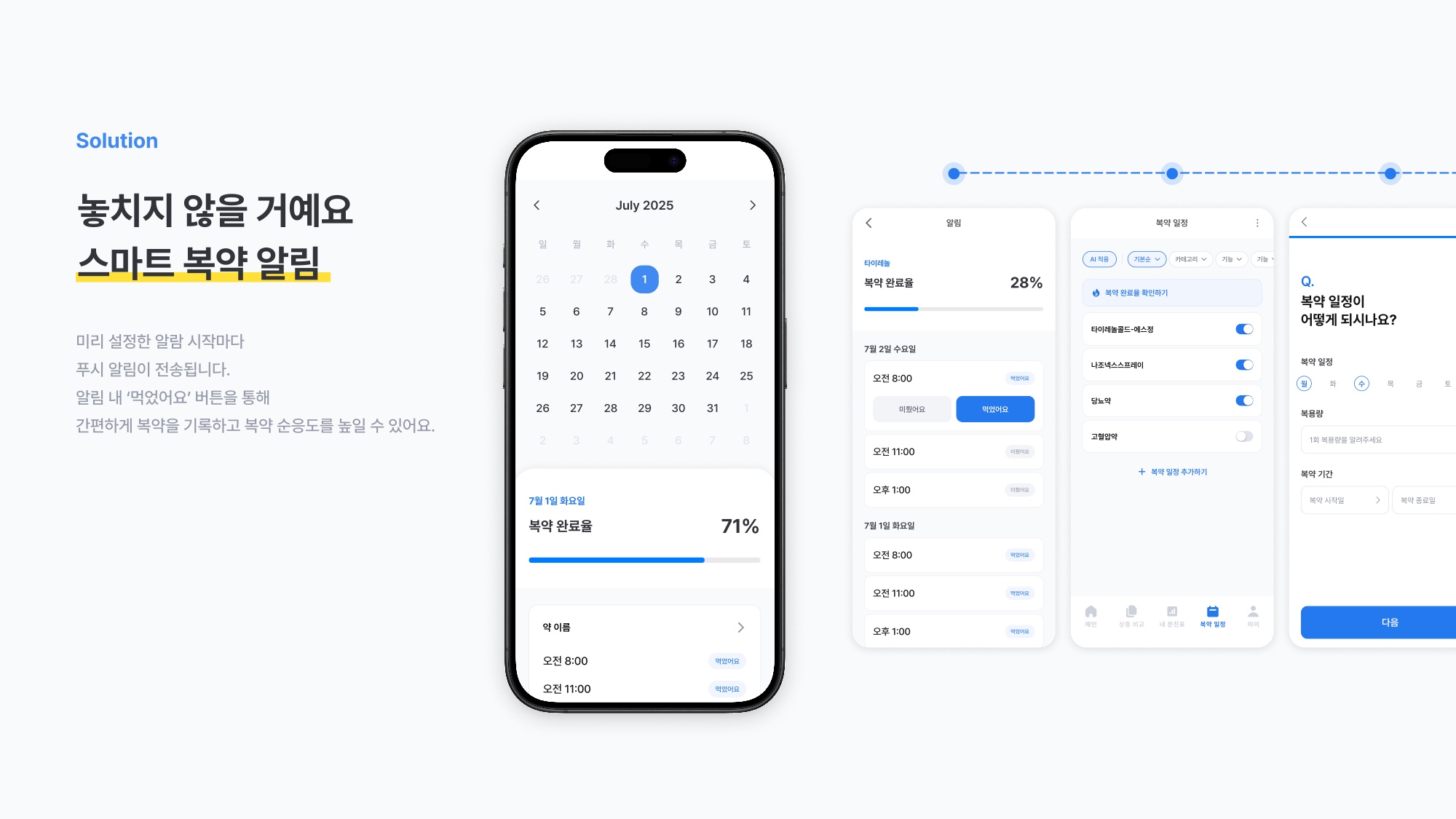
Medication reminders and logsImplemented reminders and medication logs using FCM.
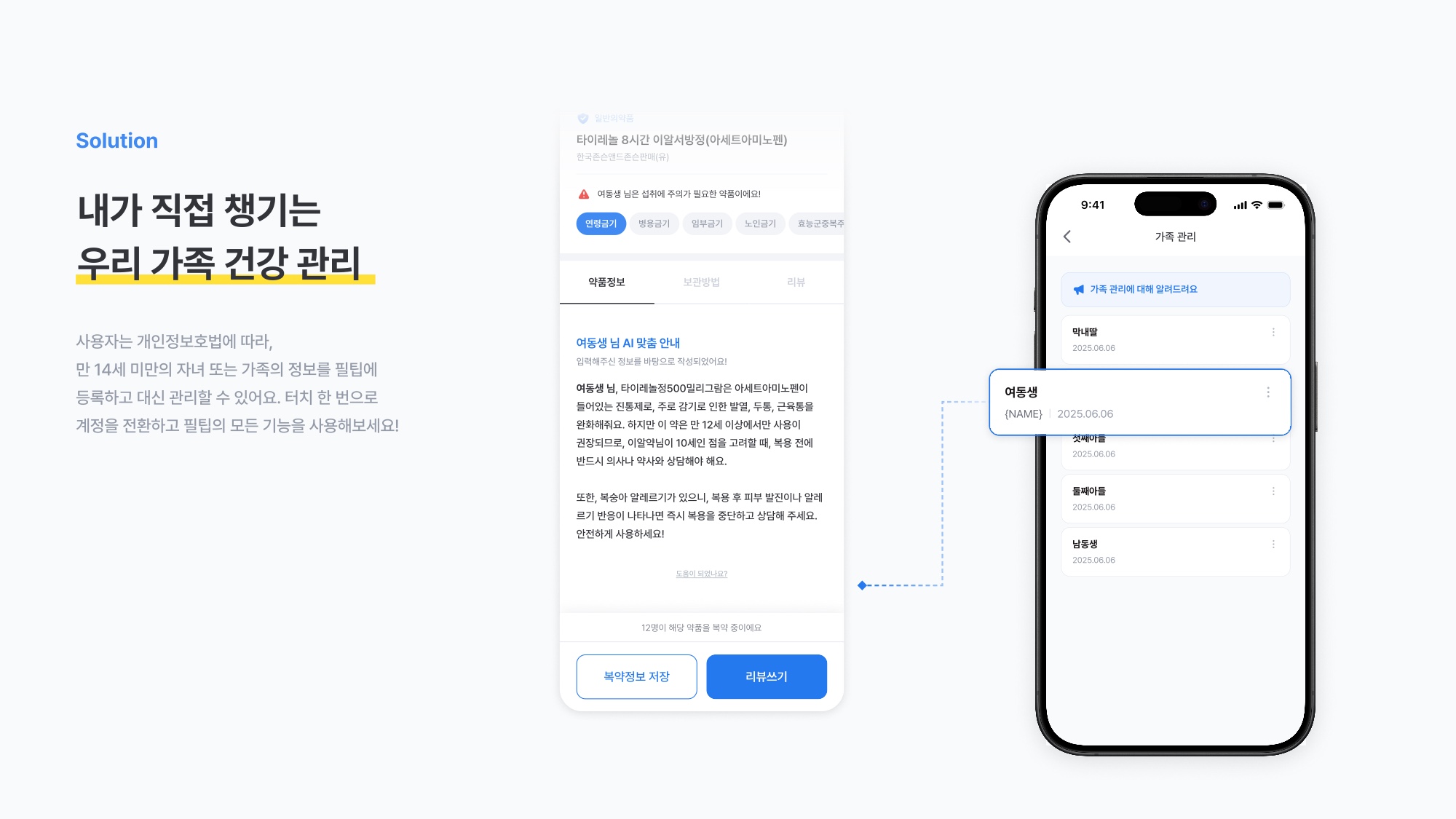
Friends and familyImplemented deep-link friend invitations and family profile switching.
Data pipeline: about $200 estimated, $11.18 actually spentBuilt a data preparation pipeline to rewrite all drug information covered by the service into friendly, everyday language.
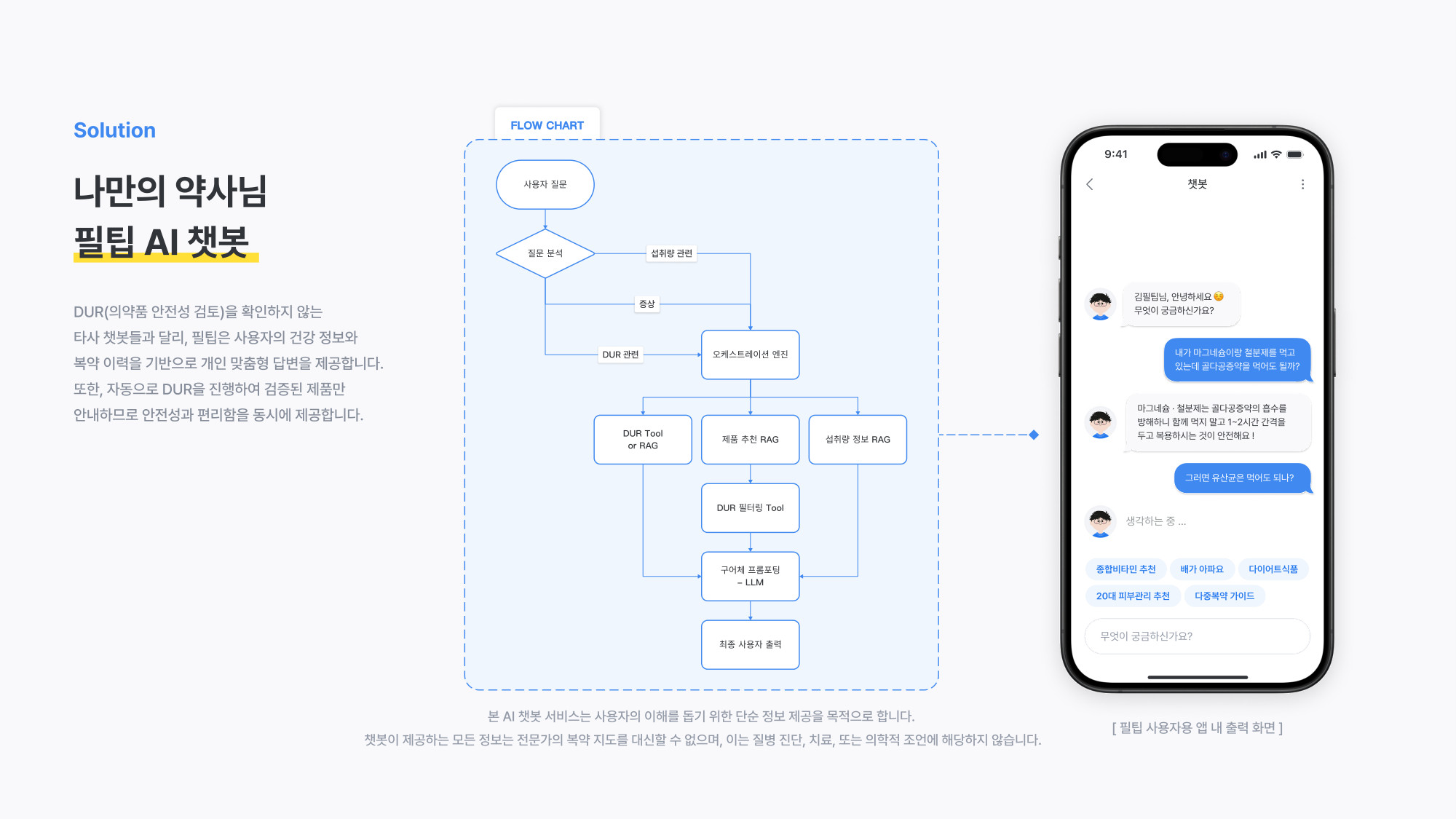
RAG-based AI chatbotBuilt an AI-orchestrated chatbot that retrieves relevant information and connects search and DUR checks according to each question.
Extended support to health functional foods after exhibition feedbackThe first service covered only drugs, and most first-exhibition feedback asked to check health supplements too. Within the supplement data obtained from public datasets, I extended search and autocomplete, caution and interaction info, medication reminders and logs, and chatbot answers, turning the requests into shipped features.
Android, 1
The Kotlin-based Android app
Backend & security, 1
User DB, login, questionnaires, AES-GCM encryption
Screens and architecture from team presentations. Captions identify my contributions. Select an image to view the original; original presentation images are in Korean.
View original size ↗Drug search and DUR — I owned the drug DB, search, autocomplete and risk information. My data pipeline rewrote descriptions in plain language. The image shows search results and caution tags.View original size ↗Medication reminders and logs — I implemented FCM notifications and medication records.View original size ↗Family profiles — I implemented switching between family members to view their medication information, as well as deep-link friend invitations. This screen shows profile switching.View original size ↗AI chatbot — I implemented orchestration between RAG search and DUR checks. This presentation example is not an evaluation of medical accuracy.
Pilltip helps users understand whether they can take a medicine right now, so I thought turning difficult drug information into easy wording was the core. To keep the feature within budget, I reduced the number and cost of model calls and processed 1GB of drug data for an actual $11.18. In 2026 I reproduced the same cleaning in PySpark to measure each step.
Pilltip has to guide medication by health condition, but I thought that health information is the most sensitive personal data. So I built a chatbot that guides medication through RAG-based AI orchestration while separating symptom-based drug search from profile-based decisions. It uses the model's language understanding, while code controls how far the sensitive profile is used.